A passport is one of the most essential travel documents in the modern world. It serves as an official identity proof issued by a country’s government, allowing individuals to travel internationally. While many people are familiar with the standard passport, not everyone is aware that there are several types of passports issued for different purposes. These types vary in terms of color, eligibility, privileges, and intended use.
A passport serves as a legal document and is mandatory for each individual to have his or her own passport – without which no international travel can be executed. In India, it is issued by the Ministry of External Affairs (MEA), which enables the bearer to travel internationally and also serves as proof of the Republic of India citizenship as per the Passports Act (1967).
In this article, we will explore the different types of passports commonly issued around the world, with a special focus on the Indian passport system, and their specific uses. There are 3 major types of Indian passport that are issued based on your profession within the country.
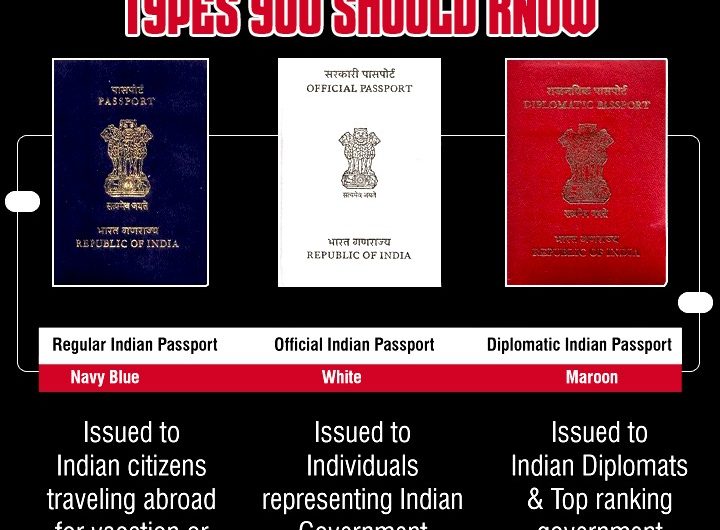
- Ordinary Passport (Regular Passport)
Color: Dark (navy) Blue
Issued to: General citizens
Purpose: International travel for personal, business, tourism, education, or employment
This is the most common type of passport issued to everyday citizens. In India, it features a navy-blue cover and is valid for ten years (for adults). It includes personal details such as the name, date of birth, address, photo, and passport number. It is used for any legal travel purpose outside the country and is often required for applying for visas to different nations.
Uses:
- Vacation or tourism abroad
- Studying in foreign universities
- Attending business meetings or conferences
- Visiting family or friends overseas
- Official Passport
Color: White
Issued to: Government employees, diplomats, or individuals representing the government on official work abroad
Purpose: Official international assignments
The official passport is granted to individuals who are traveling internationally on behalf of their country’s government. In India, it is white in color and is commonly issued to civil servants or officials of public sector undertakings traveling for work. This passport may offer certain privileges such as expedited and hassle-free immigration clearance.
Uses:
- Representing the government at international summits
- Attending foreign meetings or development programs
- Participating in international missions abroad
- Diplomatic Passport
Color: Maroon
Issued to: Diplomats, high-ranking government officials, ambassadors or people representing India at international forums
Purpose: Diplomatic missions and international relations
This passport is the most powerful amongst all the types, allowing certain immunities and privileges under the Vienna Convention on Diplomatic Relations. These passport holders are often exempted from customs’ checks and visa restrictions in many countries.
Uses:
- Representing the nation in embassies or consulates
- Negotiating international treaties or agreements
- Participating in high-level diplomatic discussions
A passport serves as more than just a ticket to cross international borders; they also reflect the purpose and nature of one’s journey. Each type of passport is tailored to meet specific needs — from regular tourists to high-ranking diplomats, and the visa is issued accordingly, based on the details and purpose filled by the applicant while applying for a specific country’s visa.
With the world moving towards the concept of ‘global village’ and ‘One Earth One Nation’, there has been an ease and relaxation in the visa issuance rules for Indian citizens by several countries, all courtesy the continual diplomatic efforts undertaken by the external affairs ministry, to make more countries visa-free or lesser paperwork based to facilitate smoother outflow of Indian citizens.
For ordinary passport holders, understanding the different types of visas offered by each of the commonly visited countries, and then choosing the preferred destination is the perfect way to plan the holiday of your dreams.
Any international travel destination comes with own set of regulations, guidelines and challenges that each traveller must adhere to, in order to avoid any constraints or plausible issues during the actual journey or upon reaching the country. The common areas one must read about include – food, language, customs, weather, culture, attire, currency and commute.
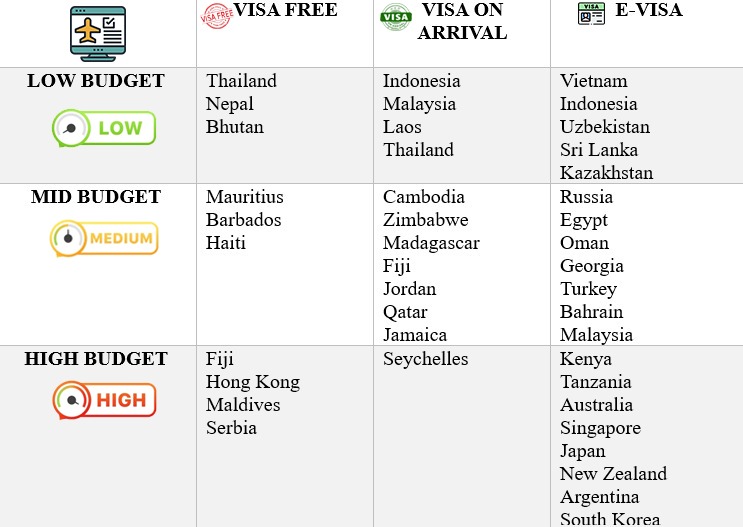
Indian passport holders enjoy easier travel to many destinations through convenient e‑Visa and Visa‑on‑Arrival (VoA) facilities. Popular e‑Visa countries include Egypt, Sri Lanka, Vietnam, Australia Singapore and many more. A large group of nations offer Visa-on-Arrival, often for 30–90 days, typically requiring proof of funds and return tickets. These include Malaysia, Thailand, Seychelles, Qatar and more.
Additionally, a few countries recently introduced visa-free entry or short‑stay eTA options. For instance, Bhutan and Nepal allow unrestricted entry under special agreements. If you possess an active and valid US or UK Visa as an Indian, then you may not require procuring the visa of the country you plan to visit – but there is a list attached to it.
Check out the links for 15 Countries you can visit with UK Visa and 10 Countries Indians can visit with a US Visa for more information on this.